How Does Minimally Invasive Bunion Surgery Work?
To perform this bunion surgery, your doctor will make tiny “pinhole” incisions and use specialized instruments to realign the bony structures of your big toe. This corrects your bunion “bump” while maintaining a healthy healing environment, which promotes a fast recovery.1,2 Because every bunion is different, your surgeon can customize the correction to your particular bunion. Depending on your condition, your bunion may be corrected without joint fusion or larger implants, helping relieve pain while leaving just a tiny scar.
Powerful Correction,
Without the Scars of Surgery
Minimally invasive surgery has been clinically proven to achieve the same or better corrective results than other more aggressive surgeries,3,4 but with major advantages. While most importantly your bunion will be corrected, there are several other key benefits that come with the Arthrex Minimally Invasive Bunionectomy.
Postoperative management is patient-specific and dependent on the treating professional's assessment. Individual results will vary and not all patients will experience the same postoperative activity level or outcomes.
Recover Up to 8 Weeks Faster
Day of Surgery
You may be able to walk immediately after surgery in a special post-op shoe without the need for crutches or a knee scooter.5,6
2 to 4 Weeks
Based on your surgeon's guidance, you may continue wearing your post-op shoe and gradually increase your activity level.5,6
6 to 8 Weeks
Depending on your healing progress, you may be able to transition to a supportive athletic shoe.1,5,6
12 to 16 Weeks
Once cleared by your surgeon, you may be able to return to your usual daily activities and preferred footwear.
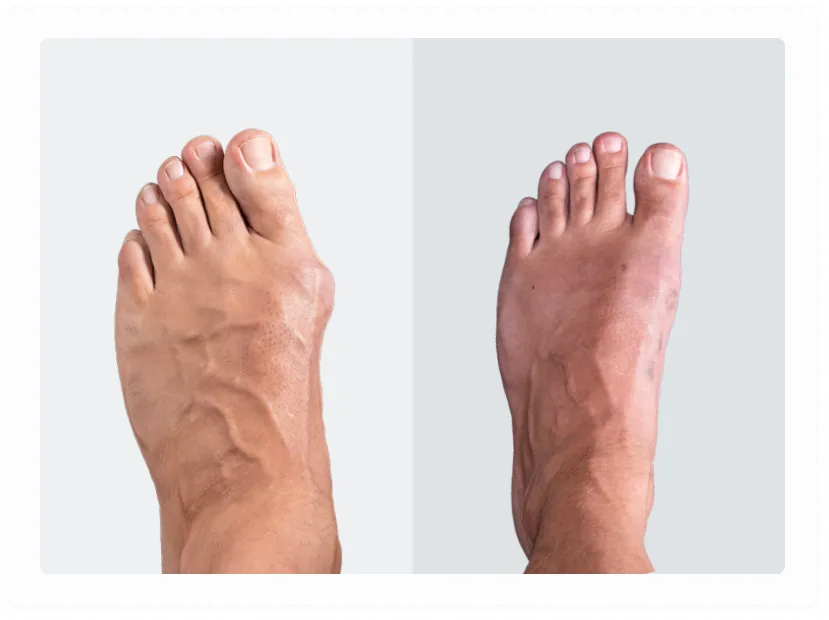
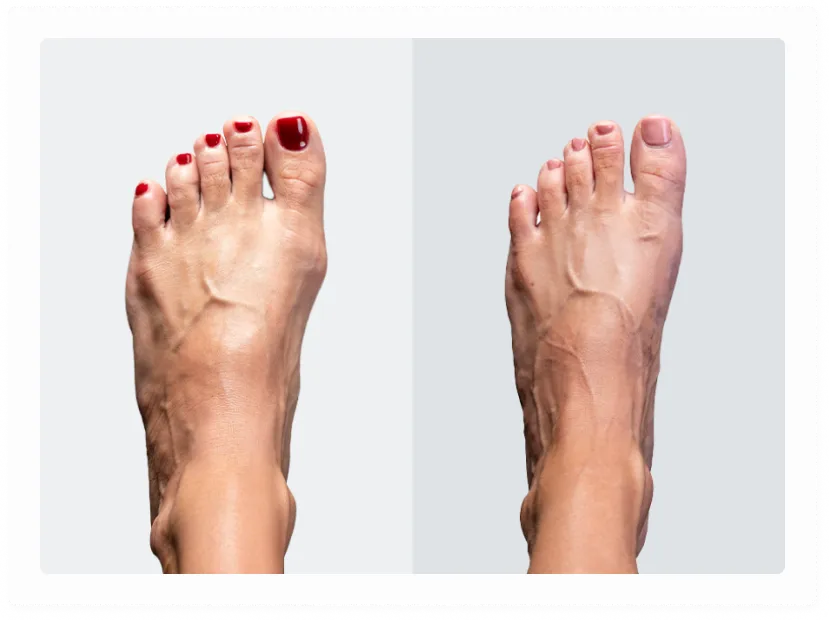
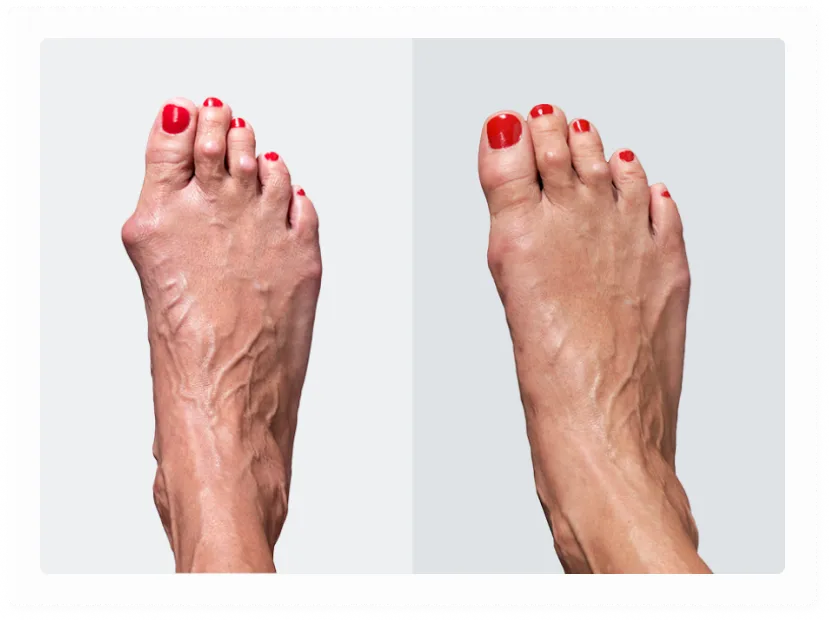
Before and After
Patient Stories
Smaller Incisions for
Less Postoperative Pain7
Small, “percutaneous” incisions act as entry portals for the specialized instruments surgeons use to perform the procedure. The ⅛- to ½-inch incisions are made on the side of the foot, as compared to traditional bunion surgeries performed through a 2- to 6-inch incision on the top of the foot (“open” surgery).11

incision size
⅛ to ½ inch
ABOUT THE SIZE OF
A grain of rice

incision size
2 to 6 inches
ABOUT THE SIZE OF
A credit card
Frequently Asked Questions
Explore commonly asked questions about the Arthrex Minimally Invasive Bunionectomy, recovery, and whether you may be a candidate for surgery.
What happens during a bunionectomy?
During a minimally invasive bunionectomy, your surgeon will make small incisions and use specialized surgical instruments to reshape and realign the big toe. Tiny screws hold the toe in its new position.
How long does a bunionectomy take?
A bunionectomy takes about an hour or less, depending on the complexity of the bunion and your individualized surgical plan. Your surgeon can provide the most accurate estimate of the length of your procedure.
Can you stand immediately after minimally invasive surgery?
Yes, many patients can stand after a bunionectomy and are often encouraged to do so. Your surgeon will provide guidance based on your individual recovery and may recommend supportive footwear to help protect your foot as you begin to heal.
How painful is bunionectomy recovery?
Pain levels vary by patient, but minimally invasive bunionectomies are designed to reduce tissue disruption. As a result, many patients experience less pain1,2 compared to traditional open procedures. Your surgical care team will provide a plan to help manage discomfort during your recovery.
How long will I need a post-op shoe or boot?
Time in postoperative shoes or boot varies based on swelling and your recovery progress. Many patients move through stages of protected footwear before transitioning into a supportive sneaker. Your surgeon will advise you when it is appropriate to change footwear.
How much swelling is normal after bunion surgery?
Swelling is a normal part of healing after bunion surgery and may affect comfort, movement, and how quickly you transition into regular shoes. The amount and duration vary by patient. Your surgeon will help you understand what to expect and when swelling should be monitored more closely.
Can a bunion come back after minimally invasive bunionectomy?
No procedure can fully guarantee that a bunion will not return, but with minimally invasive bunionectomies, bunion recurrence is rare. The recurrence rate with minimally invasive bunionectomies is less than 8%.3
Can I get a bunionectomy on both feet at the same time?
While it is technically safe to operate on both feet at the same time, it is generally recommended to have one foot operated on at a time to support a smoother recovery. Typically, surgery on the other foot should be scheduled at least 6 weeks after the first foot to allow time for healing. Your surgeon will recommend the surgical timing and approach that best aligns with your medical history, current health status, and lifestyle.
Can anyone with a bunion get an MIS Bunionectomy?
Many patients with bunions are candidates for the Arthrex Minimally Invasive Bunionectomy. This approach allows surgeons to tailor the procedure to the severity and shape of the deformity. A foot and ankle surgeon will determine if this procedure is appropriate for you after evaluation.
References
- Lee M, Walsh J, Smith MM, Ling J, Wines A, Lam P. Hallux valgus correction comparing percutaneous chevron/Akin (PECA) and open scarf/Akin osteotomies. Foot Ankle Int. 2017;38(8):838-846. doi:10.1177/1071100717704941
- Lai MC, Rikhraj IS, Woo YL, Yeo W, Ng YCS, Koo K. Clinical and radiological outcomes comparing percutaneous chevron-Akin osteotomies vs open scarf-Akin osteotomies for hallux valgus. Foot Ankle Int. 2018;39(3):311-317. doi:10.1177/1071100717745282
- Lagaay PM, Hamilton GA, Ford LA, Williams ME, Rush SM, Schuberth JM. Rates of revision surgery using Chevron-Austin osteotomy, Lapidus arthrodesis, and closing base wedge osteotomy for correction of hallux valgus deformity. J Foot Ankle Surg. 2008;47(4):267-272. doi:10.1053/j.jfas.2008.03.002
- Raikin SM, Miller AG, Daniel J. Recurrence of hallux valgus: a review. Foot Ankle Clin. 2014;19(2):259-274. doi:10.1016/j.fcl.2014.02.008
- Thomas MA, Ravine M, Siddiqui NA. Siddiqui’s tips, tricks, and pearls for minimally invasive bunionectomy. Podiatry Today. Published December 2022. Accessed May 17, 2023. https://www.hmpgloballearningnetwork.com/site/podiatry/case-study/pearls-minimally-invasive-bunionectomy-one-surgeons-decade-experience
- Siddiqui NA, LaPorta G, Walsh AL, Abraham JS, Beauregard S,Gdalevitch M. Radiographic outcomes of a percutaneous, reproducible distal metatarsal osteotomy for mild and moderate bunions: a multicenter study. J Foot Ankle Surg. 2019;58(6):1215-1222. doi:10.1053/j.jfas.2019.04.012
- Lam P, Lee M, Xing J, Di Nallo M. Percutaneous surgery for mild to moderate hallux valgus. Foot Ankle Clin. 2016;21(3):459-477. doi:10.1016/j.fcl.2016.04.001
- Kheir E, Borse V, Sharpe J, Lavalette D, Farndon M. Medial displacement calcaneal osteotomy using minimally invasive technique. Foot Ankle Int. 2015;36(3):248-252. doi:10.1177/1071100714557154
- Frigg A, Zaugg S, Maquieira G, Pellegrino A. Stiffness and range of motion after minimally invasive chevron-Akin and open scarf-Akin procedures. Foot Ankle Int. 2019;40(5):515-525. doi:10.1177/1071100718818
- Dhukaram V, Chapman AP, Upadhyay PK. Minimally invasive forefoot surgery: a cadaveric study. Foot Ankle Int. 2012;33(12):1139-1144. doi:10.3113/FAI.2012.1139
- Technique video. Accessed May 17, 2023. lapiplasty.com/surgeons/
- Maffulli N, Longo UG, Oliva F, Denaro V, Coppola C. Bosch osteotomy and scarf osteotomy for hallux valgus correction. Orthop Clin North Am. 2009;40(4):515-x. doi:10.1016/j.ocl.2009.06.003
- Bia A, Guerra-Pinto F, Pereira BS, Corte-Real N, Oliva XM. Percutaneous osteotomies in hallux valgus: a systematic review. J Foot Ankle Surg. 2018;57(1):123-130. doi:10.1053/j.jfas.2017.06.027
- Siddiqui NA, LaPorta G, Walsh AL, Abraham JS, Beauregard S, Gdalevitch M. Radiographic outcomes of a percutaneous, reproducible distal metatarsal osteotomy for mild and moderate bunions: a multicenter study. J Foot Ankle Surg. 2019;58(6):1215-1222. doi:10.1053/j.jfas.2019.04.012
- Kheir E, Borse V, Sharpe J, Lavalette D, Farndon M. Medial displacement calcaneal osteotomy using minimally invasive technique. Foot Ankle Int. 2015;36(3):248-252. doi:10.1177/1071100714557154